
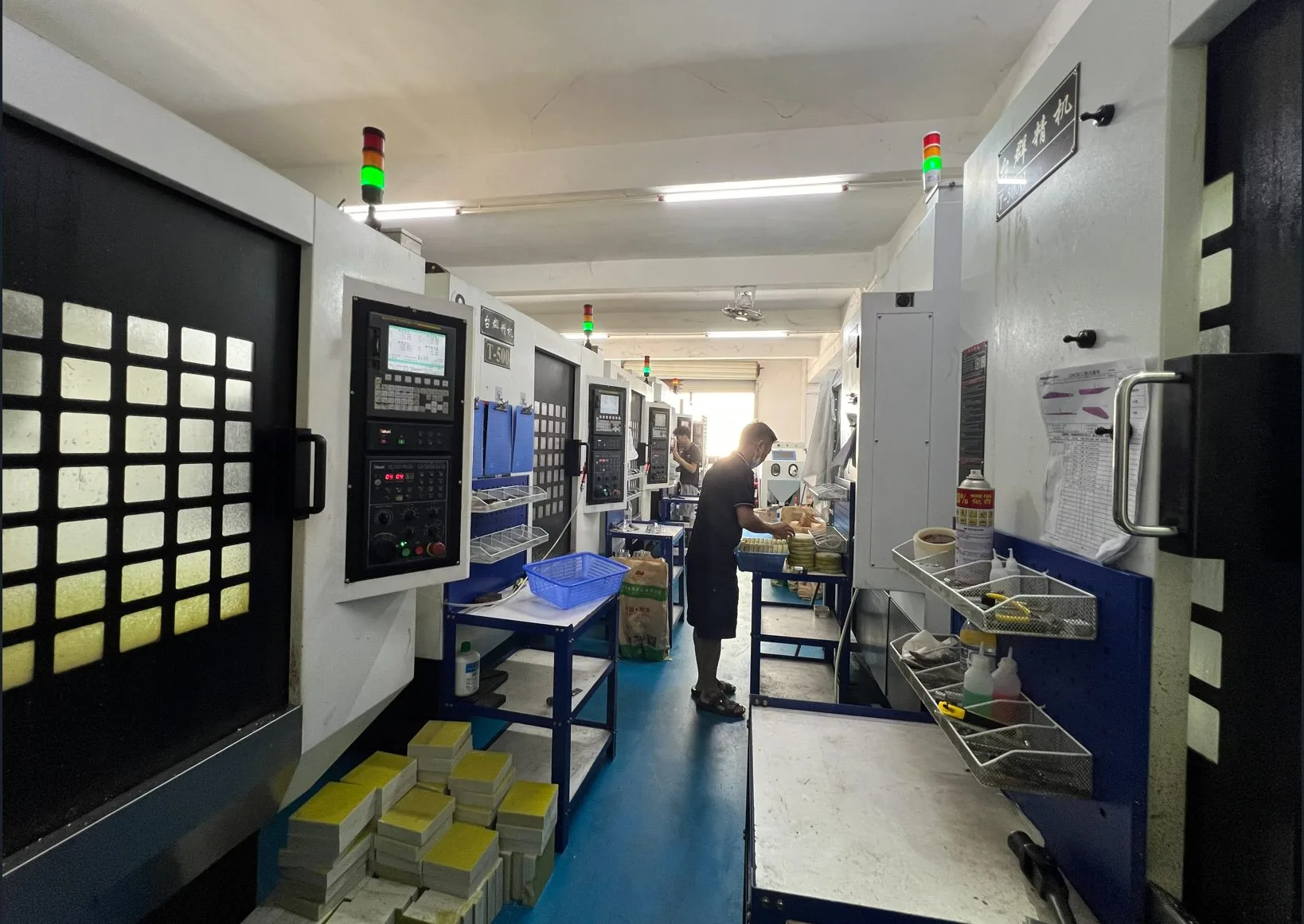
CNC milling and CNC turning are two core processes used to manufacture custom precision parts. Both remove material from a workpiece, but they do it in different ways. Milling usually uses rotating cutting tools to shape a fixed workpiece. Turning usually rotates the workpiece while a cutting tool removes material from its outer or inner diameter.
For buyers, the question is not which process is better in general. The right question is which process fits the part geometry, tolerance, material, surface finish, quantity, and cost target. Some parts are clearly milled. Some are clearly turned. Many precision parts require both.
Quick Answer
Use CNC turning for round or cylindrical parts such as shafts, pins, bushings, sleeves, spacers, and threaded components. Use CNC milling for prismatic parts such as housings, plates, brackets, enclosures, fixtures, heat sinks, and parts with pockets or flat surfaces. Use combined turning, milling, or 5-axis machining when the part has both cylindrical and multi-face features.
Key Takeaways
- CNC turning is usually efficient for parts built around a central axis.
- CNC milling is usually better for flat faces, pockets, slots, contours, and multi-side features.
- Turn-mill or secondary milling may be needed for turned parts with flats, cross holes, slots, or off-axis features.
- 5-axis machining may be useful for complex geometry, difficult tool access, or reduced setups, but it is not automatically required.
- Process selection affects cost, tolerance strategy, inspection, surface finish, and lead time.
What Is CNC Milling?
CNC milling is a subtractive machining process where rotating cutting tools remove material from a workpiece. The workpiece is usually held in a vise, fixture, or custom workholding system while tools cut pockets, holes, slots, profiles, surfaces, and 3D forms.
CNC milling is commonly used for:
- Aluminum housings
- Precision brackets
- Electronic enclosures
- Heat sinks
- Automation fixtures
- Optical mounts
- Robotics components
- Communication and SATCOM parts
- Medical device components
- Aerospace structural prototypes
Milling can be performed on 3-axis, 4-axis, 3+2-axis, or 5-axis machines depending on part complexity. The process is flexible because it can create many feature types, but tool access, corner radius, wall thickness, pocket depth, and fixture strategy all affect manufacturability.
What Is CNC Turning?
CNC turning is a subtractive machining process where the workpiece rotates and a cutting tool removes material from the outside diameter, inside diameter, face, groove, or thread. Turning is commonly performed on lathes or turning centers.
CNC turning is commonly used for:
- Shafts
- Pins
- Bushings
- Sleeves
- Spacers
- Threaded inserts
- Nozzles
- Round connectors
- Cylindrical housings
- Precision rings
Turning is often efficient for round parts because the machine can create concentric features quickly. However, if the part needs flats, cross holes, slots, keyways, or off-axis features, milling or a turn-mill process may be required.
CNC Milling vs CNC Turning Comparison Table
| Factor | CNC Milling | CNC Turning |
|---|---|---|
| Workpiece motion | Usually fixed during cutting | Rotates during cutting |
| Tool motion | Rotating cutting tool moves along programmed paths | Stationary or driven tool cuts rotating stock |
| Best geometry | Prismatic, flat, pocketed, multi-face, contoured | Cylindrical, round, axial, concentric |
| Common parts | Housings, brackets, plates, fixtures, heat sinks | Shafts, sleeves, pins, bushings, spacers |
| Strengths | Flexible feature creation and multi-side machining | Efficient round features and concentric diameters |
| Main design concern | Tool access, internal radii, deep pockets, thin walls | Diameter control, concentricity, grooves, threads |
| Cost driver | Setup count, toolpath time, material removal, fixtures | Setup, bar stock, cycle time, threading, secondary ops |
| Inspection focus | Hole location, flatness, profile, pocket dimensions | Diameter, runout, concentricity, thread fit |
| When to combine | Cylindrical part with milled flats or holes | Turned part requiring secondary milled features |
How to Choose the Right Process
Process selection should begin with part geometry. If the part is mostly round and features align with the center axis, turning is often the first process to consider. If the part has flat faces, rectangular geometry, pockets, bosses, slots, and multi-face features, milling is usually more suitable.
Choose CNC Milling When
- The part has flat mounting surfaces.
- The part includes pockets, slots, ribs, or cavities.
- The part has multiple faces that require machining.
- The design includes a complex outer profile.
- The part is a housing, enclosure, bracket, plate, fixture, or heat sink.
- Off-axis holes or threaded features are important.
- The part requires 3D contours or complex surfaces.
Choose CNC Turning When
- The part is rotationally symmetric.
- Most dimensions are diameters or lengths along an axis.
- The part is a shaft, pin, sleeve, spacer, bushing, or ring.
- Concentricity and runout are important.
- Internal or external threads are primary features.
- The part can be produced from bar stock efficiently.
Consider Turn-Mill or Secondary Operations When
- A turned shaft needs flats.
- A sleeve needs cross holes.
- A round part needs slots or keyways.
- A cylindrical housing needs side features.
- A milled part needs precise turned diameters.
The manufacturing route may include turning first, milling second, or milling first and turning later. The best sequence depends on datum strategy, clamping surfaces, tolerance stack-up, and inspection.
When Is 5-Axis CNC Machining Necessary?
5-axis machining may be useful when a part has complex multi-face geometry, difficult tool access, angled features, tight datum relationships, or surfaces that would require many setups on a simpler machine. It can reduce setup changes and improve access, but it is not automatically the most cost-effective choice.
A buyer should ask:
- Can the part be made with 3-axis milling and multiple setups?
- Will 5-axis machining reduce fixture complexity?
- Does the tolerance require fewer setups?
- Are angled features difficult to reach?
- Is surface quality improved by better tool orientation?
- Does the part value justify the process cost?
For many parts, 3-axis or 4-axis machining is sufficient. For complex aerospace, optical, robotics, or communication components, 5-axis review may be worthwhile.
Tolerance and Datum Considerations
Tolerance strategy can influence process selection. Turned parts often control diameters, concentricity, and runout around an axis. Milled parts often control hole locations, flatness, perpendicularity, pocket dimensions, and profile relationships.
If a part has both turned and milled features, the supplier should review datum structure carefully. The order of operations affects how the part is held and how features relate to one another.
For example, if a turned shaft has cross holes that must align with a machined flat, the supplier must plan how the part will be indexed and inspected. If a milled housing has a bore that must align with a pocket and mounting holes, the supplier may need to control setup, datum references, and CMM inspection.
Achievable tolerance depends on material, geometry, workholding, tooling, feature type, thermal stability, inspection method, and production quantity. It should be confirmed during DFM and quotation review.
Material and Machinability Considerations
Material affects both milling and turning. Aluminum is generally easier to machine than many stainless steels or titanium alloys, but design details still matter. Stainless steel can work harden and may require careful tooling and cutting parameters. Titanium has low thermal conductivity and needs controlled cutting strategy. Brass and some plastics may machine efficiently, but burrs, deformation, or dimensional stability can still require attention.
Material selection should be reviewed with:
- Part geometry
- Wall thickness
- Surface finish requirement
- Thread design
- Quantity
- Tolerance
- Heat treatment or temper
- Certificate requirement
- Final application
Do not select a process based only on material. A material can often be milled or turned. Geometry usually decides the starting process.
Cost and Lead-Time Drivers
Milling and turning have different cost drivers.
| Cost Driver | Milling Impact | Turning Impact |
|---|---|---|
| Setup | Multiple faces may require multiple setups or fixtures | Simple round parts can be efficient; secondary features add setup |
| Machine time | Deep pockets and high material removal increase time | Long parts, threads, grooves, and tight diameters affect cycle time |
| Tooling | Small tools, long-reach tools, and fine finishing add cost | Threading tools, grooving tools, boring bars, and driven tools may add cost |
| Tolerance | Hole positions, flatness, and profiles may require inspection | Diameters, concentricity, and runout may require careful setup |
| Quantity | Setup cost spreads across batches | Bar-fed or repeat turning may reduce unit cost when suitable |
| Finishing | Anodizing, plating, passivation, or polishing may add lead time | Same, plus protection for threads and critical diameters |
Lead time also depends on material availability, programming complexity, fixture preparation, inspection requirements, surface finishing, buyer approval, and export preparation.
Quality and Inspection Considerations
Inspection should follow the process and critical features.
For milled parts, inspection may focus on:
- Hole positions
- Pocket dimensions
- Flatness
- Perpendicularity
- Profile
- Thread depth
- Surface roughness
- Cosmetic surfaces
For turned parts, inspection may focus on:
- Outer and inner diameters
- Lengths and shoulders
- Concentricity
- Runout
- Groove width
- Thread fit
- Surface finish
- Burr control
Inspection methods may include CMM measurement where available, height gauges, micrometers, calipers, thread gauges, pin gauges, optical inspection, and surface roughness testing. The RFQ should identify critical dimensions, reporting needs, and any required measurement method before production.
Common Process-Selection Mistakes
Choosing Milling for a Simple Round Part
If a part is mostly cylindrical, turning may be faster and more cost-effective.
Choosing Turning for a Part With Too Many Off-Axis Features
If a part needs many flats, pockets, or cross features, milling or turn-mill machining may be more practical.
Ignoring Datum Strategy
Mixed-process parts need careful datum planning. The machining order can affect final tolerance relationships.
Assuming 5-Axis Is Always Better
5-axis machining can be powerful, but it should be justified by geometry, tool access, setup reduction, or tolerance risk.
Sending Only a 3D Model
Process selection may require 2D tolerance notes, material, surface finish, and critical feature information.
Mid-Article CTA
Not sure whether your part should be milled, turned, or made with a combined process? Send your CAD files, drawing, material, quantity, and tolerance requirements. A manufacturing review can help identify the most practical process before quotation.
Button: Send Your Requirements
Recommended destination: Contact/RFQ page
Buyer Checklist
Before asking for a CNC milling or turning quote, confirm:
- Is the part mostly round or mostly prismatic?
- Are there off-axis holes, flats, pockets, or slots?
- Which dimensions are critical to function?
- Does the part need surface finishing?
- Are threads internal, external, or both?
- Are there thin walls or deep features?
- Is 5-axis access needed?
- What material and quantity are required?
- What inspection report is needed?
- Is the part a prototype, low-volume batch, or repeat order?
FAQ
What is the main difference between CNC milling and CNC turning?
CNC milling uses rotating cutting tools to machine a workpiece that is usually fixed in a setup. CNC turning rotates the workpiece while a cutting tool removes material. Milling is usually better for prismatic parts, while turning is usually better for cylindrical parts.
Is CNC milling or CNC turning cheaper?
The cheaper process depends on geometry, material, tolerance, quantity, and setup. Turning is often economical for simple round parts. Milling may be more practical for housings, brackets, plates, and parts with pockets or multiple faces.
Can one part require both milling and turning?
Yes. Many precision components need both processes. A turned shaft may need milled flats or cross holes. A milled housing may need a precise bore. The supplier should plan the machining sequence and datum strategy.
When should I consider 5-axis machining?
Consider 5-axis machining when the part has complex multi-face geometry, difficult tool access, angled features, tight datum relationships, or surfaces that would require many setups. It should be chosen for practical manufacturing reasons, not only because it sounds advanced.
Which process is better for aluminum housings?
CNC milling is usually better for aluminum housings because housings often include pockets, mounting holes, threaded features, sealing surfaces, and flat faces. Turning may be used if the housing is cylindrical.
Which process is better for shafts and bushings?
CNC turning is usually better for shafts, bushings, sleeves, pins, rings, and spacers because these parts are built around a central axis. Milling may still be needed for flats, slots, cross holes, or other secondary features.
What files should I send for process review?
Send a 3D CAD file and a 2D drawing when possible. The CAD file helps with geometry and tool access review. The drawing defines tolerances, threads, finish, material, and inspection requirements.
Does material determine whether a part should be milled or turned?
Material influences machining strategy, but geometry usually determines whether milling or turning is the starting process. Aluminum, stainless steel, brass, copper, titanium, and engineering plastics can often be machined by either process depending on part shape.
Conclusion
CNC milling and CNC turning are complementary processes. Turning is usually the practical choice for round, cylindrical, and axis-based parts. Milling is usually the practical choice for housings, brackets, plates, pockets, slots, and multi-face features. Mixed parts may require both.
The best process should be confirmed through drawing review, material review, tolerance planning, surface finish discussion, and inspection requirements. A short DFM review before quotation can prevent cost surprises and manufacturing problems later.
End-of-Article CTA
Have a part drawing but not sure which CNC process fits? Upload your CAD files and requirements. JADMAKE can review the submitted geometry, material, tolerance, surface finish, and inspection information before quotation.
Button: Upload Your CAD File
Recommended destination: Contact/RFQ page